Hetzner Image Install Windows

Inhaltsverzeichnis • • • • • • • • • • • • • • • Remote Console (KVM Console) Hetzner offers a remote console which can be attached to any dedicated server. This remote console provides KVM (keyboard, video and mouse) over-IP capabilities and allows full BIOS level control of the server. It is useful for troubleshooting a server, especially in cases where SSH can't be used. The boot menu can be accessed and network configuration errors can be fixed.
The console has virtual media support, so it can be used to. The remote consoles are called 'KVM Console'.
FAQ about Dedicated Hosting. On either Linux or Windows servers. Rescue System using sshfs and part image: Install sshfs in the Linux Rescue System. Share host /IP: mirror.hetzner.de. Share name: windows. Image file with path: SW_DVD5_Win_Svr_Std_and_DataCtr_2012_64Bit_English_Core_MLF_X18-27588.iso. You will have media attached to your server. Just reboot it and you'll be able to install Windows from attached media. I found that it.
This term comes from the name of the original remote consoles that were offered. While they have since been upgraded by more modern solutions, the name has been kept. A KVM Console is free for 3 hours. If it is required for a longer period of time it can be booked for € 8.40 per additional 3 hours. Please note that Java is required when using the KVM console feature. Ordering a KVM Console Since the number of KVM Consoles in each DC is limited, we recommend clients order the KVM Console in advance via the. If you would like a KVM Console then please request one directly via the webinterface.
To do so, login to the Robot, go to 'Requests', select your server and then under 'Server requests' select 'Remote Console (KVM)'. You can then select an appointment for when you want it, and for how long you want it. Logging in Once our technicians have connected a KVM Console to your server they will send you an email with the login details, as well as the URL of the KVM Console.
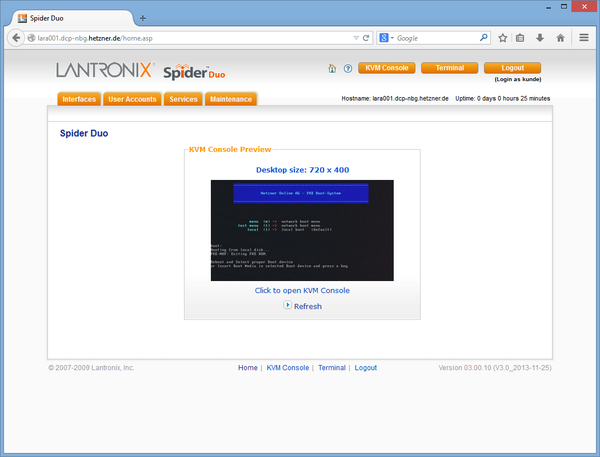
This URL can simply be clicked on, or you can copy and paste it into your browser. You will then see the following screen: Once you have logged in with the login details mentioned in the email you will see the following screen: Using the KVM Console Under 'KVM Console Preview' (see screenshot above) you can click on the screen itself to open the console, or on the 'Click to open KVM Console' link at the bottom.
A dialog box will pop-up asking what you want to do with the file 'spider.jnlp'. This needs to be opened with the 'JAVA(TM) Web Start Launcher', which should automatically be selected. Please note: • In case you do not have java installed on your computer you will need to do that first. Please go to the and download and install the latest version. • If you are using Java 7 then a security warning will pop-up. This is a general warning from Java and doesn't indicate any security problems with the java applet, and can thus be safely accepted. Once the Java applet has initialized the console should open and you will see the screen output of the server, as though you were sitting right in front of the server itself.
Keyboard Layout If the keys you are pressing on your own keyboard are not being accurately shown on the screen/console then the keyboard layout is most likely incorrectly set. This can be changed under the menu item 'Options' by going to 'Local Keyboard'. There you need to select the correct keyboard layout of the keyboard you are using. Reboot Via the 'confirm Ctrl+Alt+Delete' button at the top left of the console the server can be send a ctrl+alt+delete. This can be used to restart the server, or to login to Windows. Once you have clicked on that button you will need to confirm that you want to send a ctrl+alt+delete to the server. Full Screen Mode You can choose to have the console fill your screen if you want.
Simply Press Ctrl+F10, or one of the buttons at the top of the console with an A or S and arrows pointing outwards. Leaving full screen mode is done by pressing Ctrl+F10 again. Installing an OS The KVM Console can be used to install a custom OS. This can be done either by or having our technicians.
Please note that if you want to install one of the standard Linux Operating Systems we offer then this can be done automatically via, under the 'Linux' tab of the server, or manually via our. Mounting an ISO File To access the virtual media interface please click on the 'Interfaces' tab and then go to the 'Virtual Media' link.
Here you can enter the details of the location of the ISO file. Please note: • The KVM Console only supports the mounting of ISO files via the SAMBA (SMB)/CIFS networking protocol. • Mounting a file can take a significant amount of time, so please make sure the connection to the location of the file is good. Unfortunately, there is no progress bar.
You will see a notification once the file has been fully loaded. • We cannot guarantee that mounting an ISO file and installing it will always work. For that reason, we offer the option of having our technicians.
Acoustic Fields And Waves In Solids Pdf Download. Using our Mirror To help our clients install Windows or VMware ESXi we provide a number of images of those Operating Systems. The images we offer can be found on two of our mirrors: • is accessible from anywhere, and requires a username and password to login. These details can be found at the end of the server activation email, the email in which the login details for the server itself are also found. • is only accessible from the Hetzner network, and does not require a password. The following examples use the internal mirror, though a link to the external mirror is also mentioned.
This link can be used to check the exact file names of the Operating System images. Windows The Windows images we have can be found under. These Windows images are straight from Microsoft and don't include any changes from us. They do not come with a license, and can thus be used to install a clean Windows on the server, which can then be activated with your own license key. • The Image File with Path name can be copied directly from our mirror. • The User Name and Password fields can be left blank as they are not needed. VMware ESXi The VMware images we have can be found under The VMware images can be mounted in the same way as the Windows images (as shown above).
• The Share Name needs to be 'vmware'. • The Image File without the Path name can be used directly. • The User Name and Password fields can be left blank as they are not needed. Using the Backup Space Our backup space is reachable via SAMBA/CIFs, meaning it can be used to host an image which can then be mounted via a KVM Console.
• is the username of your backup space, which can be found under the 'Backup' tab of the server in Robot. • is the file name of the ISO file. • If you have placed the ISO file in a sub-folder then please specify that before the file name. For example: /.
• The password is the one you have set for the backup space. Using your own host The ISO file doesn't have to be hosted by us. You can host the ISO file wherever you want, as long as it is reachable via SAMBA/CIFS. This could be from another server at Hetzner, a third-party server or even from your own computer/server at your office/home. Please note that doing so can take a long time, so please be patient as the image is mounted/uploaded. Using a USB stick/DVD If the options mentioned above for mounting an ISO file don't work or take too long, then there is always the possibility of having our technicians 'burn' the image onto a USB stick or DVD and attaching that to the server along with the KVM Console. Please send our technicians a link to the ISO file you have.
This can be done when ordering the KVM Console directly, or afterwards by replying to the KVM Console request ticket. Please note that in this case the ISO file does not necessarily have to be reachable via SAMBA/CIFS, it can simply be reachable via ftp for example, since our technicians will be connecting to it directly, and not via the KVM Console. Booting the Server Once the ISO file has been mounted/attached to the KVM Console, you will need to restart the server and boot from it. This can be done via the 'KVM Console' function of the KVM Console.
When booting the server, please enter the boot menu. On most motherboards this can be done by pressing F11 during boot.
Please note that some motherboards require a different function key, like F6, to enter the boot menu, so please keep an eye out for the appropriate prompt. Install Enterprise Manager Oracle 11g Windows 7 here. Once in the boot menu select 'PepperC Virtual Disc 1 0.01' if you have mounted the file using the KVM Console. Alternatively, if our technicians have connected a USB stick or DVD then select the appropriate option to boot from that. 'JetFlashTrascend 16GB 1.00' would be an example for a USB stick, while 'HL-DT-STDVDRAM GP50NB40 1.00' would be an example for a DVD.
Installing the OS Now you can simply follow the on-screen instructions to install the OS you have mounted/attached to the KVM Console. Loading the installation files for Windows takes around a minute when done via USB/DVD but can take 10-15 minutes via a mounted ISO file (via our mirror).
If the ISO file has been mounted from somewhere else then it can take even longer.
This document describes the installation of a debian linux system on a hetzner server. Before you start you should think about how the server configuration should look like: • Which hostname should be used • What partitions do you need You should have got an email with the ip address and a root password for the server. The basic installation of the server is done by the installimage script provided by Hetzner.
The script can be used either with automatic or manual configuration. Preparation Boot Server in Rescue mode. If the server finished booting, use putty (or ssh on linux systems) to login to the server with the given IP and password.
Configuration When using automatic configuration, all configuration options for the installimage script are provides as command line arguments. The installation will start immediately without further interaction. MDM Nodes The following command will install the server with the following configuration: • RAID 1 (mirroring) • LVM • Following partition schema • Swap swap 32G • / ext4 50G • /boot ext2 512M • /opt ext4 500G • /var ext4 500G Copy and paste the following command (change the bold text to the desired host name). Copy Code installimage -a -n level365-mdm1 -r yes -l 1 -i /root/.oldroot/nfs/images/Debian-75-wheezy-64-minimal.tar.gz -p /boot:ext2:512M,lvm:vg0:all -v vg0:root:/:ext4:50G,vg0:swap:swap:swap:32G,vg0:opt:/opt:ext4:500G,vg0: var:/ var:ext4:500G BDM Nodes Maximum Space (RAID 0) The following command will install the server with the following configuration: • RAID 0 (striping!) • LVM • Following partition schema • Swap swap 32G • / ext4 50G • /boot ext2 512M • /opt ext4 250G • /data ext4 1000G Copy and paste the following command (change the bold text to the desired host name). Copy Code installimage -a -n level365-bdm1 -r yes -l 0 -i /root/.oldroot/nfs/images/Debian-75-wheezy-64-minimal.tar.gz -p /boot:ext2:512M,lvm:vg0:all -v vg0:root:/:ext4:50G,vg0:swap:swap:swap:32G,vg0:opt:/opt:ext4:250G,vg0:data:/data:ext4:1000G To change the size of the /data partition (installimage doesn’t allow partitions bigger than one disk): wait until the installimage script has finished, reboot the server in normal boot mode and issue the following commands (this will resize /data to 3000G).
Copy Code installimage -a -n level365-bdm1 -r yes -l 1 -i /root/.oldroot/nfs/images/Debian-75-wheezy-64-minimal.tar.gz -p /boot:ext2:512M,lvm:vg0:all -v vg0:root:/:ext4:50G,vg0:swap:swap:swap:32G,vg0:opt:/opt:ext4:250G,vg0:data:/data:ext4:1000G To change the size of the /data partition (installimage doesn’t allow partitions bigger than one disk): wait until the installimage script has finished, reboot the server in normal boot mode and issue the following commands (this will resize /data to 3000G). Copy Code installimage -a -n tsi-big-system-n01 -r yes -l 0 -i /root/.oldroot/nfs/images/Debian-75-wheezy-64-minimal.tar.gz -p swap:swap:32G,/boot:ext2:512M,/:ext4:50G,/data:ext4:all Configuration When the automatic configuration does not fit the needs, a manual configuration can be executed. Type in: installimage Choose operating system In the first dialog choose “Debian” In the second dialog choose “Debian-70-wheezy-64-minimal” the part “70-wheezy” is the Debian version and may change in the future Now an editor will show up where the installation configuration can be customized. An editor window will open, modify the contents that only the following entries are enabled (make sure all other entries are commented out). Adapt the bold entries to fit the needs.
Copy Code DRIVE1 /dev/sda DRIVE2 /dev/sdb SWRAID 1 # 0 = No RAID; 1 = RAID SWRAIDLEVEL 1 # 0 = Striping; 1 = Mirrorin BOOTLOADER grub HOSTNAME desired host name PART /boot ext2 512M PART lvm vg0 all LV vg0 root / ext4 1T LV vg0 swap swap swap 32G # Add other LV to the LVM if required IMAGE /root/.oldroot/nfs/install/./ [] Press F2 and then F10 to save and exit. After a security question the installation routine starts.
Installimage should finish with “INSTALLATION COMPLETE”. If installimage aborts with an error message: just try again. Reboot the system by entering: sync && reboot Wait a few minutes and then restart your SSH session.